

By Mical Imbukwa
A school day in Karare offers a completely different experience from that in most schools in the country.
In many urban centres, learners are already on the move by five in the morning, rushing through dimly lit streets in a race against time to make it to early morning preps.
But in Karare, Marsabit County, you will barely see learners until daylight has fully broken.
Karare lies within a conservation area that hosts a variety of wild animals. Elephants, hyenas and other wildlife frequently roam the vast, dry landscape surrounding the villages.
For young learners who walk several kilometres to school, venturing out in darkness is simply not an option.
This was the reality for Arbe Esther during her years at Parkishon Primary School, located several kilometres from her home.
At home, studying after sunset was also difficult with the family heavily relying on kerosene lamps and firewood for lighting, sources that were dim, smoky, and unreliable.
The effects saw many learners fall back in their studies.
Parkishon Primary School, headteacher Joseph Mirgichan, in an interview, revealed that the lack of lighting significantly affected learning outcomes.
In some instances, the limited learning hours led some students to repeat classes as they struggled to keep up.
“The lighting challenge caused delays in completing the curriculum because pupils often submitted assignments late,” he says.
But the same harsh conditions that posed a challenge for learners also offered a silver lining.
With Marsabit county sitting on the arid and semi-arid lands, where sunshine is abundant for most of the year, a funder saw this as leverage.
The intense, scorching sunlight throughout the day offered potential for leveraging on solar energy.
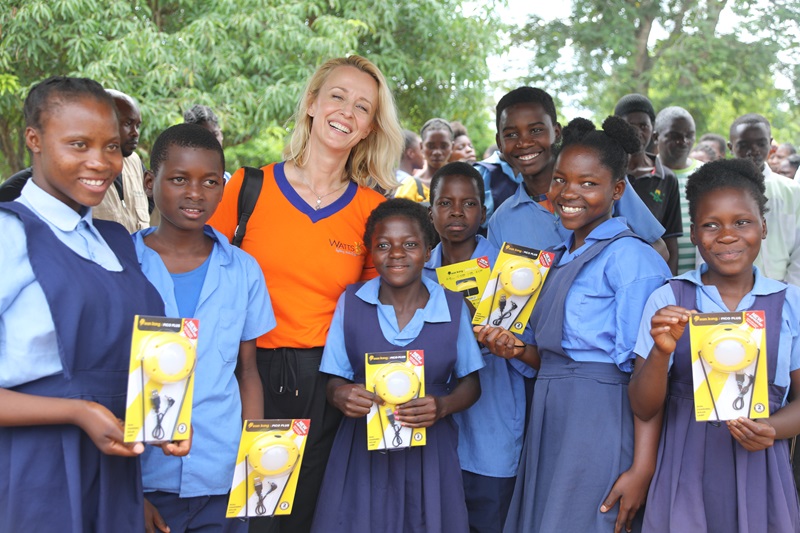
Through Econic Earth Foundation’s Watts On: Lighting Students’ Lives project, solar lamps were distributed to Grade Six, Seven and Eight learners at Parkishon Primary School and neighbouring institutions.
The small portable lamps allow students to study after sunset without relying on kerosene lamps or firewood.
The results were immediate.
“Ever since the lights were introduced, several students have proceeded to university and others are in colleges,” says Mirgichan.
Arbe Esther is one of the programme’s earliest beneficiaries.
With access to a solar lamp, she was able to plan her study time more effectively. Instead of waiting for daylight, she could complete assignments at night and prepare for school early in the morning.
“The lights enabled me to plan my time better. I was able to do my assignments at night and wake up early to prepare for school,” she says.
The lamp also served another important purpose as she could now report to school at dawn with the help of the light, which scared away wild animals along the path to school, improving her sense of safety.
Arbe went on to score 275 marks in the Kenya Certificate of Primary Education (KCPE) and secured admission to Moi Girls National School, Marsabit.
Today, she is pursuing a Bachelor of Arts in History and Religion at Chuka University.
Nicole Watson, the founder of the Econic Earth Foundation, in an interview, stated that the project, launched in 2019, targets schools where electricity has yet to penetrate.
It also targets areas where communities coexist with wildlife and has since received backing from other stakeholders, among them Faisal Kenya, Green Sun Cities, and ChildFund.
“This aligns with our goal of supporting environmental and wildlife conservation by working with students living on the frontlines of human–wildlife coexistence,” Watson says.
To date, the programme has benefitted 14,000 students in Marsabit, Kajiado, Narok, Isiolo, and Samburu counties.
Additionally, the project extends beyond Kenya, targeting learners in Zambia, Uganda, Sierra Leone, and Senegal.
The lighting project has also been credited for improving parental engagement in education and reducing health risks associated with fuel.
The lamps have also reduced the health risks associated with paraffin lamps, which produce harmful smoke.
Fancy Obuya, Programme Manager for the Nawiri Child Development Programme, one of ChildFund’s implementing partners, notes that the lamps have increased parental involvement in education.
“With solar lamps in homes, parents are now helping their children with homework. This has strengthened family bonding,” she says.
Similarly, the improved lighting has also contributed to greater security in communities.
“Women and girls told us that before the lamps were introduced, they were sometimes assaulted in the dark. Now, with the lights, perpetrators are often deterred,” Watson states.